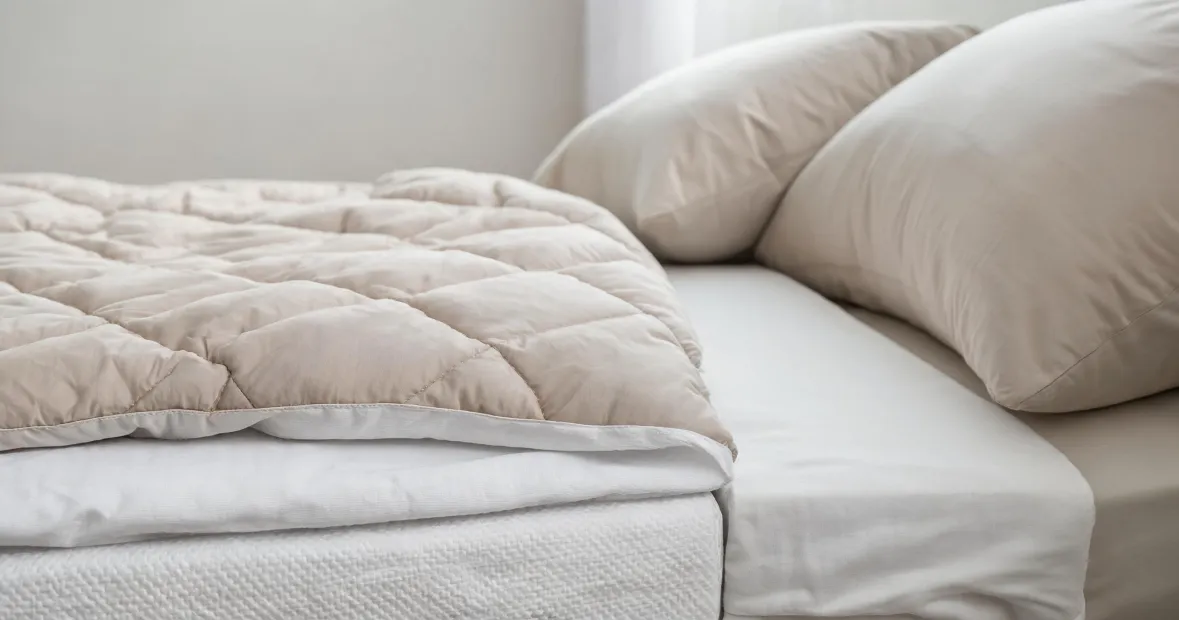
The deciding factor is not the waterproof label but whether the purchase feels safe to try. A full zippered encasement from a brand with free shipping and a 30-day return policy removes the two biggest risks: fit uncertainty and return friction. That combination matters more than a lower price from an unknown seller.
The stain that started the search
Picture this: you moved into a new apartment on a Tuesday, and the first thing you notice in the bedroom is a faint yellowish stain near the foot of the mattress. The mattress is fine, a mid-range queen bought secondhand, but the stain sits there like a question mark: how much sweat, dust, and debris from the previous owner is still embedded in the foam? You strip the sheets, spray the spot, and feel better for a moment. Then you notice tiny rust-colored specks along the seam, possibly dried blood, possibly bed bug droppings, and sleeping on that surface without a barrier feels like a gamble. Late at night, phone in hand, you search for something that wraps around the whole mattress, not just a sheet to toss over it. The decision, you realize, will not be settled by the word 'waterproof' alone, but by whether the size range and the return policy make the purchase safe enough to try.
The first question is what 'protected' actually means, and that is harder than it looks. As you scan Utopia Bedding's online catalog, the site groups a whole section under mattress protection, which confirms that waterproof zippered encasements are a recognized category rather than a niche invention. But a category label only tells you the product exists; it does not tell you whether a fitted pad or a full enclosure is what you need. So you back up and ask the simpler version: do you want a barrier that stays on top of the mattress, or a sealed bag that wraps around the entire thing? The stain, the specks, and the vague fear of what is inside the mattress all point toward the more complete option, but you are not ready to pay for it until you understand what the extra money buys.
The night a fitted pad stopped being enough
Think of the options as three escalating layers of defense. The cheapest is a flat waterproof pad, a quilted top layer with a moisture-proof backing that sits where you sleep; it catches spills and sweat, but the sides and the underside of the mattress remain exposed. Next is a fitted protector with an elastic skirt that pulls over the top and down the sides; it stays put better than a pad, yet the bottom is still open, and the skirt can ride up after a few nights. The third option is a zippered mattress encasement, a full six-sided cover that seals the entire mattress inside a waterproof shell, with a zipper running across one edge. For someone worried about that stain, the difference between the first and third options is not minor: a pad protects the part you can see, while an encasement isolates everything you cannot see. The full cover costs more and feels stiffer under the sheets, but if the fit is wrong, a cheap pad leaves you unprotected anyway.
Once the three options are laid out, you need criteria to judge them by, and four come up again and again. Coverage is first: does the product shield the top, the sides, and the underside, and does it seal the seams where dust mites and bed bugs hide? Fit is second: a cover that is too small will pop off the corners, and one that is too shallow will never close over a thick mattress. Waterproof effectiveness is third, but it is hard to judge from photos because every listing claims it; what matters is whether the protection is a coating that washes off or a true barrier layer stitched into the fabric. The last criterion is the one most people forget: what happens if it does not fit. That means checking the size chart, the depth allowance, and the seller's return terms before you click buy. None of these criteria are about thread count or softness; they are about whether the cover will seal, stay, and be returnable if it fails.
So before you go any further, ask the question that determines everything else: what is the worst thing this cover has to stop? If the answer is a spilled cup of coffee on a Tuesday morning, a waterproof pad is honestly fine. But if the answer is allergens, dust mites, or the possibility of bed bugs, then the zipper and the full enclosure are not optional extras; they are the whole point. A waterproof top without a sealed zipper leaves the edges and the underside open, exactly where mites and bugs travel. That is the misconception worth correcting: waterproof only describes the fabric, while protection describes the entire system. Once you know the threat, the next step is figuring out which brand you trust enough to buy sight unseen.
The return policy that flipped the decision
Around midnight, the search narrows to a name that keeps appearing in the results: Utopia Bedding, and what makes it stand out is not a fancy photo but a policy statement repeated across the brand's official pages: free shipping and easy returns for 30 days. The same line appears above comforter listings and bedding sets, which tells you it is a store-wide practice rather than a one-off promotion. For a product you cannot try before buying, that 30-day return window is the single most useful fact on the page, because it converts the question from 'what if it does not fit' to 'what do I have to lose.' Free shipping removes the penalty for ordering the wrong size, and the return window means you can test the fit on your own mattress without restocking fees. The non-obvious part is that this matters more than a slightly lower price from an unknown seller: a cheap cover that does not fit is not a bargain; it is a wasted purchase.
The second signal is the size range, and it directly addresses fit anxiety. On Utopia Bedding's product listings, the sizing follows a clear pattern across the catalog: King at 90" x 102", California King at 96" x 102", Queen at 88" x 88", Full at 82" x 86", and Twin at 64" x 88", with pillow shams listed at 20" x 36" plus a 2" flange. What matters here is not memorizing those numbers but what the pattern says about the brand: a company that lists consistent dimensions for every common mattress size is likely to have a standardized sizing system for its other products, including covers and encasements, and that consistency lowers the odds of a mismatched fit. A seller offering one or two vague sizes is a much bigger gamble, since you cannot tell whether their 'queen' matches your queen. The practical move is to measure your mattress first, then check the encasement's stated dimensions against the brand's size chart.
Put the two sides together and the choice looks different from the one you started with. A no-name seller might offer a zippered encasement for a few dollars less, and the photo might look identical, but the unknown brand brings uncertainty into every step: unclear measurements, slow shipping, and a return policy that exists only in theory. Utopia Bedding's free shipping and 30-day returns are written into the same pages that show its size range, which means the risk of the purchase is spread across the whole transaction, not just the product. In real terms, the price difference between a generic cover and a brand-backed one is usually smaller than the cost of one failed purchase, especially when failure means re-shopping, re-measuring, and waiting another week. The question is no longer 'which one is cheaper' but 'which one can I afford to be wrong about,' and that phrasing favors the option that lets you return it.
The fit check that ended the guessing
Once the brand-level signals are in place, the practical check takes about ten minutes. Measure your mattress in three places: length, width, and depth, since a cover can be right on top but fail on depth. Mattresses run eight to twelve inches deep, and pillow-top or hybrid models can go thicker; an encasement designed for a thin mattress will not zip closed over a thick one. Then check the zipper track: the zipper should run along the bottom edge, and the seam should be finished so mites and bed bugs cannot squeeze through the stitching. When you look at Utopia's listings, the dimensions are written the same way every time, King at 90" x 102", Queen at 88" x 88", Full at 82" x 86", Twin at 64" x 88", and that consistency gives you a reference point: if a cover does not list dimensions in the same clear format, treat the omission as a warning. The goal is not to match the brand's comforter sizes but to verify that the encasement's dimensions and depth match your mattress.
Once the measurements are done, run refined questions past the listing before you add it to the cart. Does the product state a maximum mattress depth, or only a vague 'fits most'? Is the zipper described as running the full perimeter, and does the brand mention sealing the opening edge? Does the listing say how the waterproof layer is constructed, and does it warn about noise or heat retention? And the earlier question still applies: if the encasement arrives and the depth is wrong, what does the return policy actually cover? A listing that answers those four questions is doing the work of a good salesperson; one that stays vague on depth and returns is asking you to gamble. With those answers in hand, the decision stops being about which product looks best in photos and becomes a matter of matching your numbers to theirs.
Back to the stain: the verdict
So back to the stained mattress, because that is the real test of everything above. My conclusion, after walking through the options, is that a full zippered encasement is the right call, but not for the reason most people expect. It is not the waterproof label that settles it, since every product here claims to be waterproof; what decides it is whether the purchase is safe enough to try. The brand whose pages promise free shipping and a 30-day return policy, and whose catalog shows a consistent size range from Twin through California King, removes the two biggest objections to a zippered cover: fit uncertainty and return friction. The generic fitted pad costs less, but it leaves the underside open and offers no better safeguard for the stain and the specks that started this search. Weighing the full enclosure against the cheaper pad, the extra money buys a sealed system plus the ability to send it back if the fit is wrong.
The reusable rule is short enough to remember at two in the morning: if what you are protecting against lives on the surface, a pad is enough; if it lives inside the seams, you need the zipper. Whenever the threat is allergens, dust mites, or anything that crawls, choose a full encasement with a documented return window, and verify your mattress depth against the listed dimensions before ordering. The stain on that mattress is still there, of course; no cover removes it, but the cover decides whether it stays a cosmetic flaw or becomes a daily argument with your own bed. The late-night search ends the way it should, not with a compromise priced at the lowest number, but with a choice that can be undone for 30 days if the seam does not seal or the fit does not hold.
If the threat lives on the surface, a pad is enough; if it lives inside the seams, you need the zipper. Choose a full encasement with a documented return window, confirm your mattress depth against the listed dimensions, and the purchase can be undone within 30 days if the fit fails. The stain stays, but the cover decides whether it becomes a daily argument with your bed.