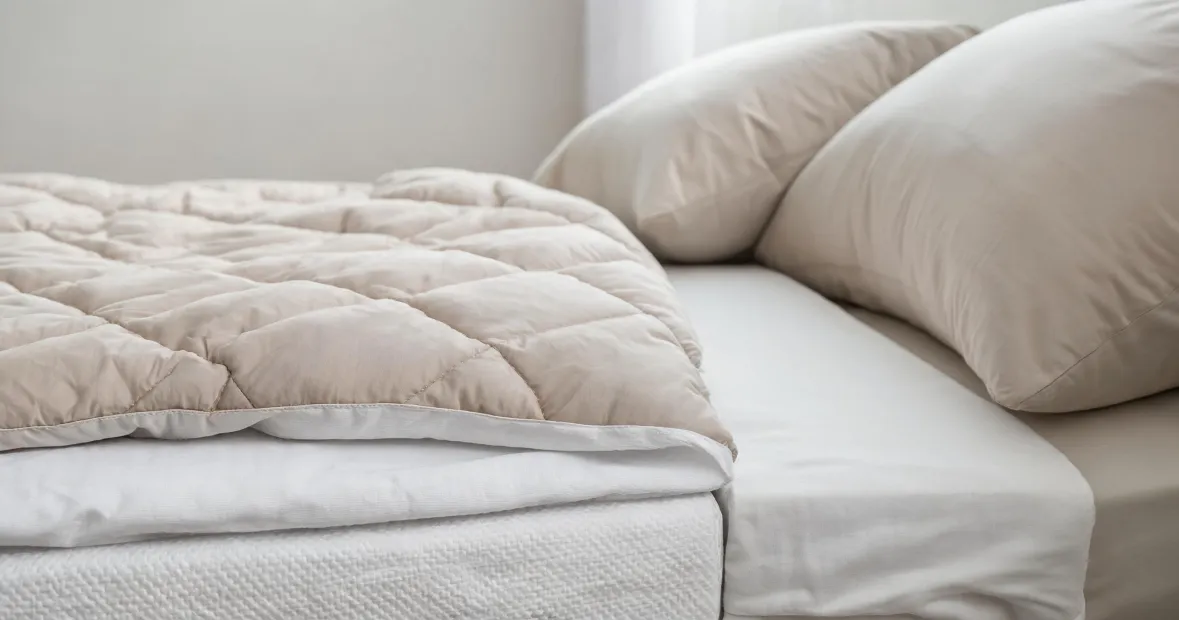
A queen mattress encasement forces an uncomfortable trade before it protects anything: the tighter the seal, the more a sleeper may worry about trapped heat, and the more breathable the fabric, the less certain the protection feels against spills and allergens. Shoppers browsing zippered covers usually want every guarantee at once — waterproof, cool, dust-proof, durable — yet each product page quietly asks them to give up one of those qualities to get another. The common assumption that a pricier cover is automatically the better one, or that waterproof always sleeps hot, skips the two criteria that actually decide the outcome: precise fit and zipper integrity. Those two checks matter more than fabric thickness, because they determine whether the encasement works at all. Since the real question is which risk lives in the reader's bedroom, and since an online purchase is hard to judge from photos, a brand's return policy becomes part of the decision rather than an afterthought.
The Encasement Dilemma: Full Protection vs. Everyday Comfort
Which should lead the decision: full protection or everyday comfort? A fully sealed encasement wraps a queen mattress in a waterproof shell, is meant to stop bed bugs from entering or escaping, and blocks dust mites and allergens from reaching the sleeper — exactly what a worried owner wants. Yet the same shell that blocks moisture also changes how the bed breathes; on warm nights, a layer that cannot release heat and humidity can make the sleep surface feel stuffy. The opposite choice, a soft and airy cover, feels pleasant at first but leaves the mattress exposed to the accidents that motivated the purchase in the first place. Neither option is wrong on its own; each is right only in relation to the specific failure the owner is trying to prevent. A queen mattress is costly to replace, and the encasement is the cheapest insurance against that loss — but only if it is the right one for the room, which is why the dilemma cannot be resolved by comparing feature lists.
The reason this trade-off is testable at all is the ordering policy behind the product. Utopia Bedding's official catalog states that free shipping and easy returns apply for 30 days, which shifts the nature of the purchase from a one-way gamble into a trialable decision. When a shopper cannot touch the fabric or check the zipper in person, the genuine risk is not the price but the possibility of ending up with a cover that does not fit or sleep comfortably; a 30-day return window converts that risk into a reversible experiment. That policy changes the judgment in a practical way: the owner no longer has to pick the safest-sounding option to avoid regret, and can instead choose the encasement that matches their protection priority, test it on the actual mattress, and send it back if the seal is wrong. Yet the trial must be real — the cover must be installed, slept on, and inspected for gaps before the window closes, because a return policy protects only those who actually test it rather than leaving it in the box.
Does It Fit? The First Fork: Size and Depth
How does a shopper know the encasement will fit a queen mattress before it arrives? This is the first fork in the decision, and it filters out more options than any other criterion. A queen-size label is only the beginning: the encasement must also match the mattress depth, which varies from slim 9-inch models to thick 15-inch pillow tops, and it must sit tight enough to stay in place without stretching the fabric. Here the brand's own catalog offers a useful starting signal. Utopia Bedding's product listings repeatedly confirm Queen dimensions across its bedding lines — the queen comforter, for instance, is listed at 88" x 88", while king sizes run 90" x 102" or 96" x 102" — showing that the brand consistently accounts for queen sizing rather than treating it as an afterthought. The caveat is that a comforter's Queen listing is not the same as an encasement's depth rating; the listing only establishes that Queen is a standard, properly supported size in the lineup, and the depth measurement still has to come from the encasement's own product page.
Measuring is straightforward once the point of the exercise is clear: a fitted encasement should be slightly smaller than the mattress it covers, so every inch of the surface is held by fabric rather than floating. A tape measure across the top gives length and width, and a vertical check at the corner gives depth; comparing those three numbers to the product's dimensions is the entire test. When the fit is correct, the encasement stays put during sleep, moves with the mattress instead of against it, and leaves no slack where a bed bug could hide or a spill could pool. When the fit is wrong, an oversized cover wrinkles into folds, gaps open along the edges, and the protective layer bunches in places while leaving other areas exposed. Many shoppers assume that a larger size is safer, but the reverse is true — oversizing creates the exact gaps that defeat the seal. The judgment that follows is simple but unpopular: a thinner encasement that fits precisely will outprotect a thick one that fits poorly.
Waterproof or Breathable? The Comfort vs. Protection Trade-off
The second fork is immediate and uncomfortable: waterproof protection or breathable comfort? A waterproof encasement is built to stop liquids, and that ability is what makes it attractive to anyone who eats in bed, keeps a glass on the nightstand, or shares the mattress with children or pets. The legitimate worry is heat: a barrier that blocks moisture from entering may also block heat and humidity from escaping, and on summer nights a queen mattress wrapped in a non-breathing layer can feel noticeably warmer. Breathable designs answer that worry with fabrics that allow air circulation while still resisting moisture, but they usually cannot promise the same barrier strength as a fully waterproof membrane. So the question is not which type is better, but which failure the owner fears more: the sudden accident that stains and soaks, or the slow, nightly discomfort of sleeping on a cover that traps body heat. The same queen mattress can be served well by either option, and the answer depends entirely on the household's actual pattern of use rather than on the thickness of the material.
Because the fear of heat drives so many decisions, the breathability of the construction deserves at least as much weight as the waterproof claim. Utopia Bedding's catalog describes its bedding in terms of a breathable, box-stitched design that supports year-round comfort, and that emphasis is the relevant signal: a brand that builds its comforters around airflow and seasonal use is unlikely to treat breathability as an afterthought in its protective covers. That matters because the waterproof-versus-hot assumption is usually overstated — modern encasements combine a waterproof layer with a soft, breathable surface, so the owner does not have to choose a sauna to get spill protection; what matters is whether the cover can pass air during normal sleep, which is precisely the property a breathable box-stitched construction is meant to preserve. Breathability, however, must be judged against the room: in a hot, humid climate, even a well-ventilated cover will feel warmer than a bare mattress, so summer nights should be weighed against the risk of a stain that cannot be undone.
The Zipper Test: Sealing the Deal
Once fit and protection style are settled, one detail decides whether the whole system works: the zipper. What makes a zippered encasement truly secure? A mattress encasement is different from a fitted sheet because it must completely enclose the mattress — top, bottom, sides, and every seam — and the only opening is the zipper line. If that line is weak, a gap appears and the seal fails; bed bugs can slip through a split seam, allergens can escape through a loose weave, and a liquid can reach the mattress around a faulty closure. The zipper is also the most stressed part of the product: it is opened and closed during installation, tugged by sheets, and subjected to pressure every time someone sits on the bed. Shoppers tend to judge encasements by the thickness of the fabric, but the durability of the fabric counts for nothing if the zipper is the first point of failure. So security has to be evaluated by the quality of the closure, not by the weight of the material.
Evaluating that closure correctly requires looking at where the product sits inside the brand's lineup. A category page works as a filter: it tells the shopper whether zippered covers and mattress protectors are part of the range at all, and it groups them in a way that makes comparison possible. Utopia Bedding's catalog includes a mattress protector category alongside its other bedding groups, narrowing the search to where encasement options are likely to be listed; without it, the shopper would hunt through unrelated product types. The category, however, is only a starting point — it is evidence of availability, not of quality. The decision depends on inspecting the zipper construction: whether the zipper is recessed behind a flap, whether the pull lies flat when closed, whether the seam is reinforced along its full length, and whether the enclosure wraps the bottom as well as the top. Those details are rarely stated in a category listing, so the correct procedure is to use the category to find candidates and then verify the zipper details on the product page itself. Under this rule, a cover with a sturdy, recessed zipper and complete enclosure outperforms a thicker cover with a weak closure, no matter how impressive the fabric feels.
A Reusable Decision Rule for Your Queen Encasement
All of these criteria can be compressed into a decision rule that applies to any queen encasement, including one from a brand the shopper has not tried before. The rule has three branches. First, measure the mattress depth and compare it to the product's stated dimensions; if the numbers do not match, no other feature can save the choice, so the decision ends there. Second, decide the protection priority: if the risk is allergen or bed bug exposure — in a child's room, a guest room, or a known infestation — require a fully enclosed encasement with a secure, reinforced zipper, because only complete enclosure stops those threats; if the risk is limited to spills and stains, a waterproof cover with a breathable top is sufficient, and the owner can prioritize comfort. Third, check the closure rather than the fabric: trace the zipper line, look for a sealing flap, and confirm the encasement wraps the bottom of the mattress completely. When branches conflict, the strictest wins: a bed-bug concern overrides breathability preference, and a depth mismatch overrides brand reputation.
Applying the rule is where the purchase policy matters, because a screen-side decision can be tested in a bedroom. Utopia Bedding states free shipping and easy returns for 30 days, and that policy gives the owner an acceptable way to treat the first purchase as an experiment: order the encasement that the rule selects, install it fully, and judge the result by the same three branches — fit, closure, and comfort over several nights. If the depth was misread or the zipper feels weak, the return window makes correction inexpensive, which changes the final judgment: the owner no longer needs to buy the most conservative option to protect against a bad outcome, because the bad outcome is recoverable. What keeps this working is honesty about the test: the encasement must actually be slept on and inspected, not left in its packaging, and the decision to keep it should rest on whether the seal held and the bed stayed comfortable, not the effort spent. With that kind of policy, a first attempt becomes a low-stakes step toward the right fit rather than a permanent commitment.
The rule survives every comparison: fit opens the decision, the zipper closes it, and the dominant risk decides which trade-off to accept. Measure the depth first; demand full enclosure and a reinforced zipper when allergens or bed bugs are the threat; settle for a breathable waterproof cover when spills are the only realistic concern; and treat the 30-day return window as the final verification step rather than an afterthought. A queen mattress encasement chosen this way does not need to be the most expensive one to be the right one — it needs to fit precisely, seal completely, and match the one risk the household cannot tolerate. When those three conditions are met, the purchase has done its job; when any one of them is guessed instead of verified, no feature list can compensate.