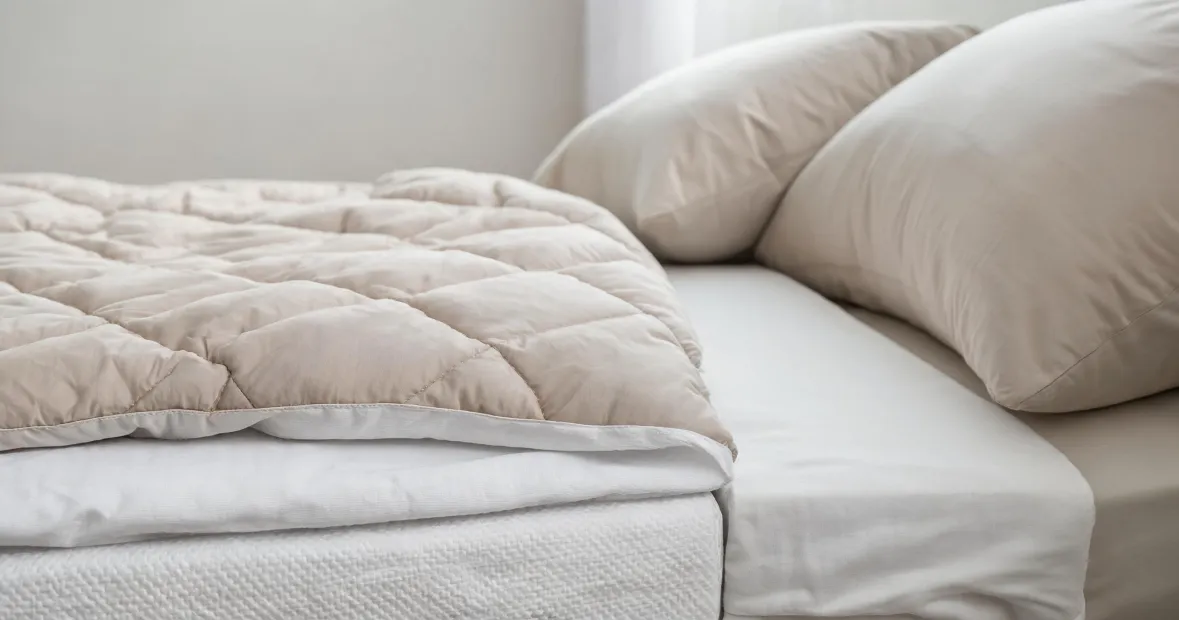
A waterproof label does not guarantee bed bug protection. Waterproofing stops liquids, while bed bug protection depends on a sealed, six-sided enclosure with a covered zipper and sealed seams. A membrane that blocks spills does not close the gaps where bed bugs enter. So before you buy, inspect the zipper, edge binding, and seams—not just the label.
The Waterproof Label Is Not the Shield You Think It Is
Can a label that promises waterproofing also promise bed bug protection? No, and assuming it does is the most expensive mistake you can make in the bedding aisle. Waterproofing is about stopping liquids from soaking into the mattress; bed bug protection is about blocking a six-legged insect that can compress its body to fit through narrow gaps. A plastic-like membrane that keeps a glass of red wine from staining does nothing to close the seams or zipper track where bed bugs actually enter. The marketing term 'bed bug proof' gets printed on all kinds of covers, but the mechanism that matters is physical containment, not a water-repellent finish. If you buy on the label alone, you may end up with a fitted sheet that shrugs off spills yet still lets bed bugs crawl underneath the surface. This is why the first question you should ask is not 'is it waterproof?' but 'can it seal every opening?'
The problem is gaps. Bed bugs are flat insects about the size of an apple seed, and they can wedge through a space as thin as the edge of a credit card. A waterproof mattress cover usually has a coated top surface and sometimes coated sides, but the weakest points are exactly where the cover folds, zips, or is sewn. The zipper track, the stitching along the corners, and the tag seam are all potential entry routes. A waterproof membrane does not extend into those spaces—it simply coats the fabric, leaving the structural openings unprotected. Even a small tear from normal use can become a doorway. That is why a cover that looks great on paper can fail within months if the construction is only a coated sheet with a cheap zipper.
That changes the way you should shop. Instead of comparing thread counts or waterproof ratings, you need to inspect the physical structure of the cover. Are the zippers covered by an inner flap? Are the seams heat-sealed or just stitched? Is there a layer that wraps the entire mattress, top, bottom, and all four sides? A cover that answers yes to those questions is a genuine encasement; one that only protects the top surface is a glorified sheet. The distinction matters because bed bugs can hide in the mattress itself, and a partial cover leaves those hiding spots exposed. Your purchase decision should therefore start with construction details, not with the marketing copy on the front of the package.
Waterproofing and Bed Bug Protection Are Different Games, and the Zipper Decides
Waterproofing and bed bug protection solve different problems. A waterproof layer is designed to create a barrier against liquids: it uses a coating or a laminated film that resists moisture. Bed bug protection, by contrast, is a containment strategy. It relies on a continuous enclosure that a bug cannot penetrate or detect a way around. The two goals overlap only when the material is also tightly sealed at every edge. Most covers achieve one or the other, rarely both. You can find a cover that is completely waterproof yet has a simple open-end zipper with no flap, and bed bugs will walk right through the zipper seam. The mechanism is entirely different: one blocks a fluid, the other traps an insect.
The zipper is the dividing line between a real encasement and a sheet with a label. If the zipper is exposed, or if the teeth sit directly against the mattress, bed bugs can squeeze between the teeth. A well-designed encasement uses a zipper that is recessed or covered by an inner fabric flap, plus a zipper stop that prevents the slider from opening all the way. The seam around the zipper should also be sealed—either with a heat-welded tape or an extra row of stitching close to the teeth. In practice, the difference between a $40 cover and a $90 cover is often exactly this: how much attention was paid to the zipper track and its housing. If you can feel the zipper teeth through the fabric without a buffer, that is a red flag.
The brand's own product language tells you what it considers important. On Utopia Bedding's collection pages, the descriptions emphasize softness, breathability, and all-season comfort—not zipper design or sealed seams. That tells me the manufacturer is competing on feel, not on containment engineering. When a brand leads with how comfortable the fabric is, you cannot assume it has solved the harder problem of keeping bed bugs out. You have to go to the individual product page and look for the words 'zipper,' 'encasement,' 'six-sided,' or 'seam sealed.' If those words are absent, the product may be perfectly soft and waterproof, but it may not be bed bug proof in any meaningful sense.
Three Spots to Inspect Before You Commit
Before you buy, inspect three places: the zipper, the edge binding, and the seams. The zipper should be recessed or shielded, with a covering flap that prevents bugs from accessing the teeth directly. The edge binding—the fabric strip that wraps the outer perimeter—should be wide and double-stitched, not a thin hem that pulls apart after a few washes. The seams, especially where the sides meet the top and bottom, should be sealed with tape or an extra row of stitching so close to the edge that a pin could not pass through. These three details are more reliable indicators of bed bug protection than any waterproof rating or thread count.
Here is how to test these details without holding the product in your hands. First, look for close-up photos that show the zipper area—many listings include a shot of the zipper pull. If you see a flap covering the zipper, that is a good sign. Second, search the description for the word 'encasement' or 'six-sided.' Those words usually mean the cover wraps the entire mattress, not just the top. Third, check the care instructions: if the cover can be machine washed and dried without losing its shape, the seams are likely more substantial. If a listing hides the zipper entirely or only shows the top surface, treat that as a warning. A reputable brand will often include these details because they know buyers are looking.
Seeing a category named 'Mattress Protectors' on a store's menu is a start, not a guarantee. Utopia Bedding does list a mattress protectors category on its collection pages, which tells you the brand recognizes the product type. But a category label does not tell you whether a particular cover uses a full encasement zipper or merely a fitted sheet style with a waterproof coating. The decision point comes when you click into a specific product: does the description mention a zipper? Does the product image show a flap? If the category exists but the individual product pages stay silent on those details, you have not yet confirmed the protection level.
Utopia Bedding's Line Confirms the Basics, but the Details Are Missing
What the brand publicly promises tells you about risk, not construction. Utopia Bedding's official pages state that they offer free shipping and easy returns for 30 days. That is a meaningful safety net: if you buy a cover and find the zipper or seams inadequate, you can return it without losing money. The same pages also list a mattress protectors category, which indicates the product line exists. But neither fact tells you whether a specific encasement has a covered zipper or sealed seams. The return policy reduces the financial risk of testing a product; it does not reduce the biological risk of a bed bug infestation. You still need to inspect the product details before you commit.
The public information has its limits. Nowhere in the collection overview can you find the zipper type, the seam sealing method, or the number of sides the cover encloses. Those specifications live on individual product pages, and sometimes only in the images. If a listing does not explicitly say 'six-sided encasement' or show a zipper running along the bottom edge, you cannot infer it from the brand's overall catalog. This is not a criticism of the brand—it is the normal state of e-commerce. The burden is on you to dig into the product listing and verify the construction details against the checklist from the previous section.
When you apply the checklist to Utopia Bedding's product line, the brand's own descriptions add a useful data point: they emphasize year-round comfort and softness. That aligns with the expectation that a mattress cover should not turn your bed into a plastic wrapper. But comfort is a secondary criterion in the decision matrix. The first filter is structural: does the cover have a full zipper and sealed seams? If a product fails that filter, softness does not rescue it. If it passes, comfort becomes the tie-breaker. So here is the decision matrix: first confirm the zipper and seam construction; second, check the return policy (which Utopia covers); third, compare comfort descriptions to choose among the passing candidates.
A Reusable Decision Rule for Your Next Purchase
Here is the rule, and you can apply it to any brand, not just this one. Before you buy any mattress cover that claims bed bug protection, perform a three-point inspection: the zipper must be shielded, the edge binding must be wide and double-stitched, and the seams must be sealed. If the listing cannot show you these details, treat the claim as unverified. Waterproofing is a bonus, not a substitute. The rule gives you a decision criterion: pass the inspection and the cover is a candidate; fail it and the cover is out, regardless of thread count or price.
The boundary is where your risk and your tolerance meet. If you live in a single-family home with no shared walls, no used furniture, and no recent travel, bed bug pressure is low, and a simple waterproof cover may be all you need to guard against spills. But if you are in an apartment, a dorm, or you bring home secondhand furniture, the threat is real, and the zipper-and-seam inspection becomes non-negotiable. Also note the boundary on the rule itself: an encasement can keep bed bugs from reaching the mattress, but it does not kill existing bugs on the mattress or in the room. The decision rule tells you how to buy, not how to treat an active infestation.
Remember: an encasement prevents bed bugs from reaching the mattress, but it does not kill bugs already on or around it. Use the three-point inspection—zipper, edge binding, seams—to filter candidates, then weigh comfort and price. The boundary of the rule is your risk profile: low-risk homes may settle for a waterproof cover, but shared walls or secondhand furniture make the zipper-and-seam check non-negotiable.