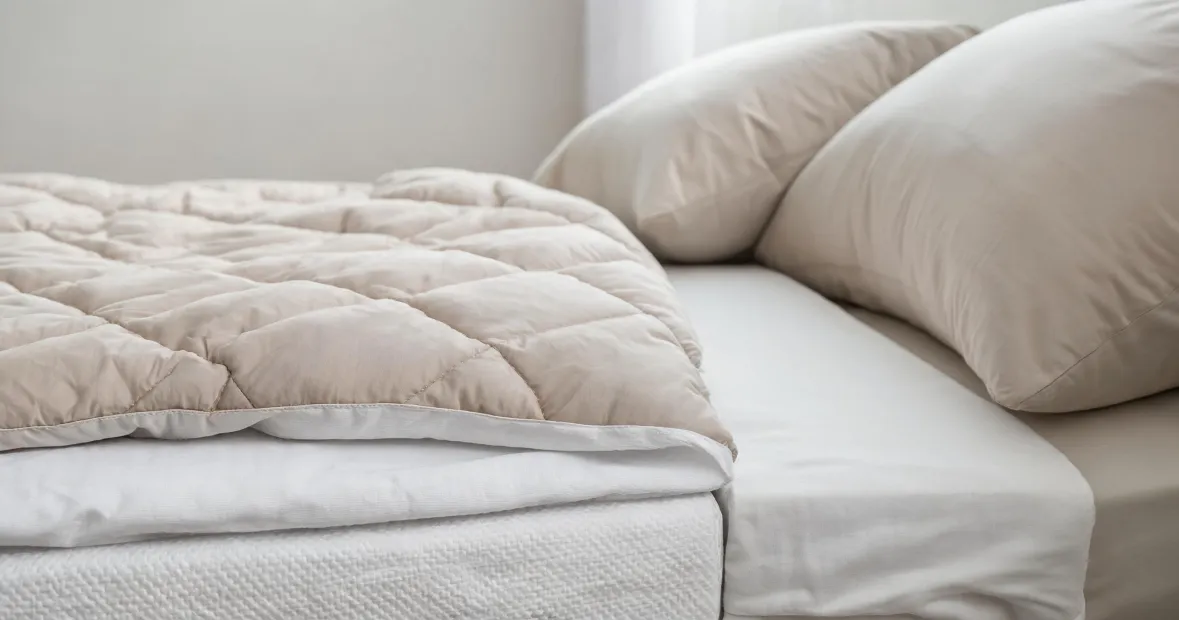
Short answer: a zippered encasement earns its price only when it seals all six faces of the mattress and matches the actual depth of the bed. A protector that straps over the sleep surface does a different job. It keeps the top fabric clean and handles what lands where a person lies, but the sides and underside stay bare, and those are the surfaces where liquid wicks along the seam and where bed bugs and dust mites move between the mattress edge and the frame. The material printed on the package settles almost nothing. What decides the outcome is whether the closure completes a sealed shell, and whether the size you order matches the mattress you measured. Because returns run 30 days, the sizing half of that test is cheap to correct. The closure half is the part you cannot fix after delivery.
What a Zippered Encasement Actually Covers (and What a Fitted Pad Doesn't)
The two products are usually merchandised side by side, and that is where the confusion starts. A zippered encasement is a closed shell: coated fabric across the top, the four sides, and the bottom, with a zipper running along one or more edges, so the core is never left exposed to air or to whatever is spilled on the bed. A fitted protector is an open pan by comparison, held against the sleep surface by elastic or a skirt, with everything below left bare. Category browsing tends to collapse both under the phrase mattress protector, and search strings built for the waterproof, zippered, bed-bug-proof segment are useful only as a first filter. They point at the right shelf, not at the right product. The narrower question worth answering is what has to be true for the zippered version to deliver something the fitted version cannot.
The distinction is not academic. In the brand's own navigation, Mattress Protectors sits as its own collection entry rather than a filter buried inside a general bedding category, and it appears alongside Pillow cases & Protectors and Bed Skirts and Ruffles — three separate categories that each address a different exposure problem. That merchandising choice tells you the retailer expects shoppers to arrive with a structural need rather than a general wish for bedding. The reason matters: the ways into a mattress core are not on the sleep surface alone. Liquid spilled at the edge of a bed wicks sideways through the ticking and along the side seam before it reaches the center. Dust mites colonize seams and the underside, where humidity collects. Bed bugs travel along the foundation and the frame and settle at the piping and the bottom fabric. Covering the top face leaves every one of those routes open.
Two expectations need trimming before purchase, because both are common and both lead to disappointment. First, an encasement is a barrier, not a cleaning device. If a mattress has already absorbed urine, sweat, or a pet accident, sealing it afterward contains the exposure but does not remove the residue or the odor, and a heavily soiled core usually needs replacing rather than wrapping. Second, a zippered shell is not a substitute for washable linens. Sheets, and ideally a light pad over the shell, absorb daily friction and body oils and go through the laundry on a weekly rhythm; the encasement underneath is meant to be installed once and washed rarely, because every cycle is wear on the coating and the zipper. A buyer who expects to strip and launder the whole shell as often as a sheet has chosen the wrong product class, and the mismatch shows up quickly as a leaking track and a stiffening surface.
Why the Zipper Track, Not the Fabric, Decides Whether Waterproof Holds
A mattress rarely gets ruined by one dramatic flood. It gets ruined by three small, repeatable entry routes. The first is the zipper track: a closed zipper is a mechanical seam of interlocking teeth and a slider, and unless the slider parks fully at the end of the track, a few millimeters of open channel remain. The second is the stitch line where the top panel meets the side wall; every needle hole is a perforation through the coating, and under body weight the fabric stretches until those holes widen. The third is plain exposure — any side or bottom face left uncovered. Product copy seldom addresses this directly. Across the brand's own listings, descriptive text on bedding items spends its words on what is included and on inch measurements, which is a fair signal that dimension and construction are where a buyer's attention belongs.
That is why the outcome changes so sharply once a shell closes fully and fits. When the underside, four sides, and top are one continuous piece of coated fabric, and the zipper terminates inside a flap that overlaps the track, spilled liquid stops at the surface: it beads, it pools, and it lifts away with a cloth instead of soaking into the core. Sizing is what makes the closure work. The listings state dimensions in explicit inches — 90" x 102" (King Size), 88" x 88" (Queen Size), 82" x 86" (Full Size), 64" x 88" (Twin Size) — and accessory items carry their own figures, such as 20" x 36" + 2" Flange for pillow shams. Those exact numbers exist because a shell has to match a mattress in three dimensions, depth included. A shell one size too large bunches into folds that channel liquid toward the track; one too short pulls the track apart at the corners.
There are situations where the full shell is the wrong instrument, and naming them keeps the recommendation honest. A guest room used two weeks a year, a mattress replaced on a predictable schedule, or a household whose only realistic threat is dust rather than liquid does not need a sealed perimeter; a fitted protector that gets washed often will do the job with less fuss. Likewise, when a mattress already sits inside a manufacturer's own non-removable cover, a second zippered shell adds friction between layers and can make the bed feel firmer than intended. What matters is not how much protection a product claims but which failure mode you are actually trying to prevent. If that failure mode is an overnight accident, a pet, or a used mattress moved into a shared apartment, the perimeter is the part you cannot leave open.
Fit, Depth, and Sizing: The Step Buyers Skip Before Ordering
Size mismatch does not fail dramatically on day one. It fails over months, at the points where fabric sits under constant tension. A shell too shallow for a thick mattress keeps the side wall stretched, and the zipper track stays under load every time someone sits on the edge of the bed. A shell too deep for a thin mattress folds the excess inward, creating ridges under the fitted sheet and a pocket of slack around the track. In both cases the coating flexes more than it was designed to, and flexing is what opens stitch holes and eventually crazes the laminate. Sellers that publish a size for every variant, as this brand does by naming dimensions inline with each product rather than burying them in a chart, are effectively inviting that check. The measurement worth taking is the mattress depth at the corner, not the nominal thickness on the sales tag.
The reward for measuring correctly is that the shell sits flat. Tension spreads evenly across the top panel and the side wall, the zipper closes without resistance, and the assembly stays put when the sheets are changed. Get the fit wrong and one of two costs appears: the loose version abrades against the mattress and wears through at the corners where friction concentrates, while the tight version strains the slider and the track fails first. On the retailer's side, the commercial terms are simple and public — free shipping and easy returns for 30 days, stated on the collection page and repeated in product copy. That policy is only useful if it is used for the right problem. It makes a wrong size recoverable; it does not make a wrong structure recoverable, because a fitted protector that leaves the sides bare will keep leaving them bare after every exchange.
So the pre-order routine is three measurements and one comparison. Length corner to corner, width edge to edge, and depth from the top surface down to where the mattress meets the foundation — that last number is the one buyers skip, and it is the one that decides whether a zippered shell closes cleanly or fights you on every linen change. Then match the published figures exactly: the same catalog lists sizes in explicit inches, including 90" x 102" (King Size), 96" x 102" (California King Size), and 88" x 88" (Queen Size), which is precise enough to compare against a tape measure without guessing. If a mattress falls between two depth bands, take the deeper one, because extra fabric can be tucked while a shallow shell will not stretch. Keep the 30-day return window in view as the backstop for the cases where the tape measure still disagrees.
Care, Lifespan, and the Rule I'd Apply Before Buying
Two forces govern how long a coated shell lasts, and both are about heat and mechanical abuse. Waterproofing in these products is a surface treatment or a laminated layer rather than the fiber itself; hot water and a high-heat dryer cycle stress that layer each time, and a coating that has stiffened or crazed stops shedding liquid even though the fabric still looks intact. The zipper is the other consumable. Grit trapped in the teeth grinds the slider, and hauling a loaded track around a corner applies lateral force to teeth meant to move in one plane. In practice that means a cool or warm wash, a low dryer setting, and a closed zipper before laundering, plus a look at the slider, which should sit fully closed once the cycle ends. Because the material is not what fails first, the washing habit rather than the purchase price sets the replacement interval.
Which brings the choice back to scenario rather than price. A fitted protector suits a household where the threat is ordinary and immediate — coffee, sweat, a child who occasionally wets the bed — and where the priority is that the item goes into the wash with the sheets and comes out the same afternoon. A zippered encasement suits the cases where exposure cannot be reversed by laundering: a pet that marks the bed, a mattress of unknown origin, a building with a history of bed bugs, a rental where the furniture is not yours. The catalog is organized around that kind of decision, carrying dimensions and composition inline with each listing and treating fabric as a separate navigation facet, which reflects how buyers compare structure and size before they compare material. If the two product classes still look interchangeable to you, the exposure you mean to prevent has not been named yet.
The rule I would apply before buying a zippered encasement has two gates and one tiebreaker. Gate one: does the product close on all six faces with a track that terminates past the corner, or is it an open pan that only covers the sleep surface? Gate two: does the listed size, in inches, match the length, width, and measured depth of the mattress, with a shell that tolerates slightly extra depth rather than too little? The tiebreaker is maintenance — whichever option you can genuinely keep clean on a weekly rhythm is the one still doing its job a year from now. Everything else, from the fabric name to the adjectives in the product title, is secondary, and the specifics of composition and available sizes should be confirmed on the brand's own product page before ordering, since those figures move with the SKU. That is the whole test, and it requires trusting no claim about being fully waterproof.
Judge a zippered mattress encasement on two verifiable things and nothing else: whether the closure completes a sealed shell over all six faces, and whether the size matches the mattress you actually measured, depth included. If both hold, the product does something a fitted protector cannot — it keeps liquid and crawling insects away from the core, not just away from the top. If either fails, the extra spend buys friction and a false sense of security. Everything above that line is marketing language; everything below it is a maintenance habit. Buy the shell that closes and fits, and the question of whether the price was justified stops being a matter of opinion.