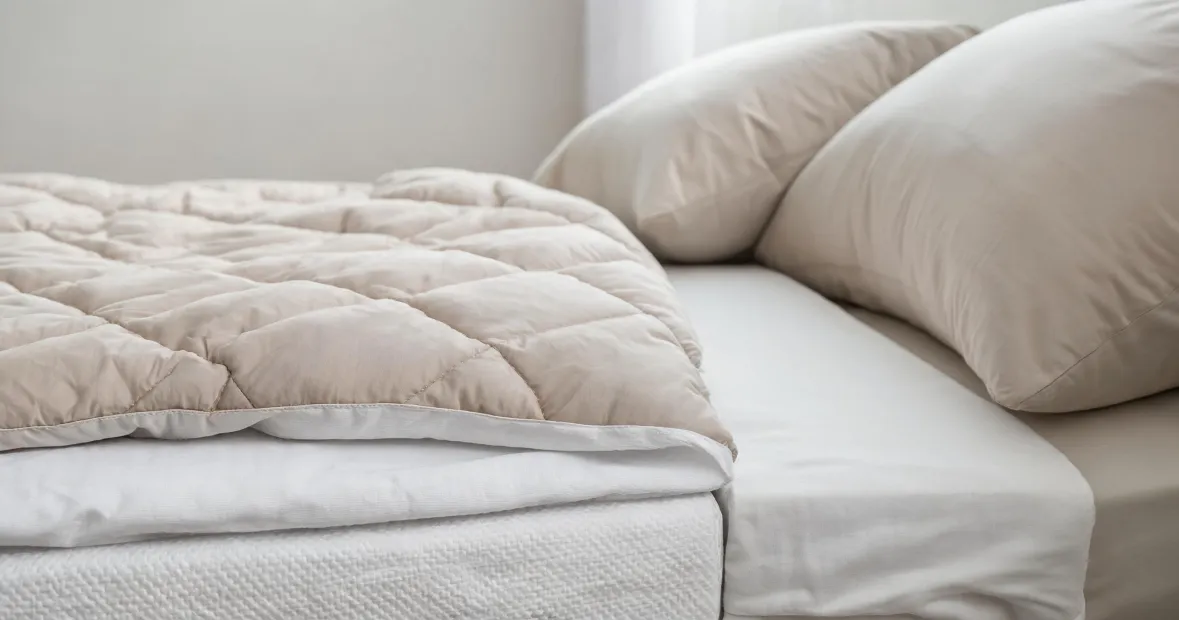
Queen mattress owners face a familiar online shopping puzzle: the zippered encasement that promises total protection costs noticeably more than a simple waterproof pad, while the cheapest option may not even zip around the mattress. The real decision is not about the brand name or the price tag—it is about which features actually turn a cover into a true barrier. For a Utopia Bedding zippered mattress encasement in queen size, the answer depends on three things: full zipper coverage that wraps the entire mattress, size information that matches your specific mattress depth, and a return policy that lets you test the fit without losing your money. Without those, even a respected seller’s product can disappoint; with them, the purchase becomes a straightforward, low-risk choice rather than a gamble.
A Queen Mattress Is Worth Protecting—But Which Encasement?
Should you buy a zippered encasement, or is the cheaper flat protector enough for a queen mattress? The answer changes once you understand what each product actually does. A mattress protector sits on top of the mattress, shielding the sleeping surface from spills and dust, but it leaves the sides and bottom exposed. A zippered encasement, on the other hand, wraps the entire mattress—top, sides, and bottom—and closes with a zipper that runs around the perimeter. That full enclosure is what makes an encasement different, and it is also why the word 'encasement' is often misused in product listings. A listing may call something an encasement when it is really a fitted protector with elastic corners, which does nothing to seal the mattress from pests or allergens. So the first question is not whether to buy a cover, but whether the cover you are looking at actually seals the whole mattress. For queen-size beds, this distinction matters more than you might think, because bed bugs and dust mites do not stay on the surface—they hide in seams, crevices, and the underside of the mattress.
This distinction points to a practical rule: treat any product description as incomplete until you can confirm the zipper wraps the full perimeter. Category listings, even from established brands, only tell you that the brand has a mattress protector line; they do not tell you whether a specific item is a full encasement or a top cover. For example, a category-page excerpt for Utopia Bedding mentions mattress protectors and shows a range of bedding items, but it does not by itself prove that every item in that line is a zippered encasement. The useful signal is that the brand lists concrete sizes across its catalog—queen comforters at 88" x 88", king sizes at 90" x 102", and so on—which suggests that the company is comfortable disclosing dimensions and expects buyers to care about fit. That habit of clear labeling makes it easier for you to check the specific encasement listing, but you still have to read that listing yourself. The rule is simple: use category browsing to find candidates, then open the product page and look for the words 'zippered encasement,' a full-perimeter zipper description, and queen-specific measurements before you add anything to the cart.
What Does a Zippered Mattress Encasement Actually Do?
What does a zippered mattress encasement actually do that a flat protector cannot? The core difference is in the design and the seal. A flat protector is a single layer of fabric that lies on top of the mattress, so it catches spills on the surface but leaves the sides, bottom, and seams fully exposed. An encasement, however, is built as a full shell: top, side, and bottom panels sewn together, with a zipper that runs around the entire perimeter. Once that zipper is closed, the mattress sits inside a sealed envelope. This design stops bed bugs from entering or escaping, prevents dust mites from gathering in the seams, and keeps a spilled drink from wicking into the mattress’s side. It also means the encasement must match the mattress’s dimensions exactly—not just its length and width, but also its depth. A deep pillow-top queen mattress can fail to zip shut inside a cover marked only 'queen,' which is why the product’s size specification, especially depth, is not a minor detail but the deciding factor between a working encasement and a frustrating return.
With that understanding, you can evaluate any encasement listing by asking a few pointed questions. Is the zipper described as running around the full perimeter? Does the product page give a specific depth range or mattress-height limit? Is the fabric described as waterproof and breathable, or does it only say 'water-resistant'? These questions apply to every brand, and they are also where a brand’s product-description habits become useful. Utopia Bedding’s catalog, for example, shows a consistent pattern of size disclosure: queen comforters are listed at 88" x 88", king sizes at 90" x 102", and pillowcases with a 20" x 36" dimension plus a 2" flange in some sets. That level of specificity across bedding items suggests the brand expects buyers to care about exact fit, and it is a reasonable reason to expect that a zippered encasement from the same seller will include similar dimensional details. However, you still need to confirm the encasement’s own numbers, because a comforter size does not translate to a mattress cover size. The evidence does not tell you the encasement’s depth range; it tells you the brand has a culture of publishing measurements, which makes it more likely that the encasement listing will be complete enough for you to verify the fit.
Is Utopia Bedding a Brand You Can Trust for This?
Is a brand like Utopia Bedding trustworthy enough for a purchase that depends on precise fit? Trust in a mattress accessory is not about star ratings alone; it is built on two practical signals: the clarity of the product description and the ease of returning the item if it does not work. A brand that sells a wide range of bedding is more likely to have refined its encasement designs than a seller with a single generic listing. Utopia Bedding’s official page states 'Free shipping & easy returns for 30 days' and shows a catalog filled with size-labeled products—queen sets, king sets, and multiple comforter types with dimensions like 88" x 88" and 90" x 102". That return window is a concrete form of insurance for an encasement, because fit is impossible to judge from photos or specs alone; you need to put the cover on your actual mattress to know whether it zips smoothly and feels comfortable. A 30-day return policy means you have a full month to do that test. The brand’s willingness to offer that window suggests it is confident that a correctly sized item will meet expectations, and it gives you a direct way to test that confidence with your own queen mattress. The catalog also includes seven-piece and three-piece sets and refers to 'five-star comfort' in its descriptions, reinforcing that the brand is an established bedding seller with a broad product range rather than a one-off listing.
Those trust signals help, but they have limits. The 30-day return policy reduces financial risk; it does not tell you whether the encasement’s zipper is the full-coverage type or whether the fabric will feel comfortable for eight hours. To make the brand’s reliability work for you, pair the return window with product specifications. Utopia Bedding lists concrete dimensions for its bedding—queen comforters at 88" x 88", pillowcases at 20" x 36" with a 2" flange—which shows a habit of giving measurable details. That habit matters because a queen mattress can vary in depth, and an encasement with a stated depth range is easier to match. If a product page lacks those numbers, the return policy becomes your only safety net, and you should be prepared to use it within the 30-day period. In other words, the brand’s reliability is not a promise that every item is perfect; it is a promise that you will have the information and the time to find out. A responsible shopper uses those two tools together: check the specific encasement dimensions first, and if the page is missing them, treat the 30-day window as a contingency rather than a substitute for verification. Set a reminder to test the encasement as soon as it arrives, and compare the measured depth of your mattress against the product’s stated range before you decide to keep it.
What Specs Should You Verify Before Buying a Queen Encasement?
Before you click checkout, which specs should you verify on the exact encasement you’re buying? Start with the zipper: does the description say the zipper runs around the entire mattress, or just on one side? A true encasement zips close on three or four sides, fully enclosing the mattress, rather than just having a single seam. Next, check the dimensions—length, width, and depth. A standard queen mattress is roughly 60" x 80", but depth ranges from around 8" to 14" for pillow-top models. An encasement that lists only 'queen' may not fit a thick mattress, so look for a depth range or specific inch measurements. Then look at the fabric and waterproof layer, and finally read the return policy for the item you are actually ordering. The order of these checks matters: the zipper confirms the product type, the dimensions confirm fit, the fabric affects comfort, and the return policy determines your risk if any earlier check fails. These four checks take about a minute, but they separate a product that protects your mattress from one that gets returned after a frustrating night of wrangling with a too-small cover.
These checks are not just theory; they are the difference between a product that works and one that gets returned. Utopia Bedding’s product entries, for instance, consistently include item counts and dimensions—seven-piece sets, three-piece sets, queen comforters at 88" x 88", pillow shams at 20" x 36" with a 2" flange—which means the brand’s team is comfortable putting hard numbers in front of buyers. That is exactly the level of detail to expect from an encasement listing. If the encasement page gives you a queen size but no depth, treat that as a red flag and look for the model’s dimensions elsewhere or contact customer service. A straightforward spec sheet tells you the zipper will close without forcing, and the size will align with your mattress; a vague one leaves you guessing. The same logic applies to the fabric: if the description says only 'waterproof' but not 'breathable,' you may end up with a cover that feels like a plastic bag. So the final step is to check that the encasement you choose includes the depth and zipper details, and that the return policy covers your test period. If those are present, the product is likely to do the job; if they are absent, no amount of brand reputation can replace them.
The 30-Second Decision Rule for Your Queen Mattress
How do you turn all this into a decision you can make in under a minute? You do it by using a short checklist instead of comparing every feature. Ask whether the product is a true encasement with a full perimeter zipper, whether the listed queen dimensions match your mattress depth, and whether the seller clearly states a return policy. Each of those three checks filters out most bad purchases. A product that fails the first two is unusable; a product that fails the third is a gamble with your money. Utopia Bedding happens to pass the third check on its site, but the first two still need verification on the specific encasement listing. The checklist works because it ignores marketing adjectives and focuses on the three elements that determine whether the product can physically seal your mattress and whether you can recover your money if it does not. It also helps you avoid paying for features you do not need: for ordinary allergen protection, you do not have to seek a medical-grade certification if the zipper and fit are right. That is the entire decision in its simplest form, and it is fast enough to apply in any online store.
With those three checks, the rule becomes concrete: buy the encasement if the zipper is full-length, the dimensions fit your queen mattress, and the return window is at least as long as the shipping time you need to test the fit. Utopia Bedding’s official site prominently advertises 'Free shipping & easy returns for 30 days,' which means you have a full month to put the encasement on your mattress and decide. If it does not zip closed or feels too stiff, you can send it back within that window. That combination—a product with clear specs and a return policy that protects you—is what turns a risky online purchase into a low-risk one. The decision rule is not about brand loyalty; it is about verifying the three essentials and using the seller’s own guarantee as the final safety net. For the specific case of a queen mattress, you can translate the rule into two concrete actions: measure your mattress depth before ordering, and order from a size that provides at least a 30-day return window. If both are satisfied, the encasement is worth trying; if either is missing, the purchase is not justified by the price.
Choose the Utopia Bedding zippered encasement for your queen bed only if the listing confirms a full zipper and dimensions that match your mattress depth, and place the order knowing the 30-day return window lets you test the fit first. That is the whole decision: verify the seal, confirm the size, and rely on the return policy as the safety net that makes the experiment affordable.